The AI endpoint that charges you money when somebody abuses it
Abuse of a normal endpoint costs you capacity. Abuse of an endpoint that calls a model costs you money per request while everything looks healthy. Four controls, and the quota bug that charges you for every rejection.
- security
- ai
- appsec
- webdev

Every other part of your product costs you capacity when someone abuses it. Servers work harder, response times climb, and if it gets bad enough you add machines. Unpleasant, recoverable, and broadly proportional to how much traffic you are getting.
The endpoint that calls a language model is different in one specific way: it bills you per request, on someone else's meter, whether the caller is a customer, a script or a stranger who found it. Abuse there does not degrade your service. It transfers money out of your account, in real time, while everything looks healthy.
That difference is worth understanding by whoever watches the budget, not only by whoever writes the code, because the failure is financial before it is technical.
Who you are actually defending against#
The mental image of an attacker is unhelpful here. Nobody has to break anything, find a vulnerability, or take any interest in your product at all. They have to call an endpoint in a loop.
There are two populations worth thinking about separately.
The first is people who want free access to a model. An unauthenticated endpoint sitting in front of a paid model is a free API key that somebody else pays for, and there are people who systematically look for those. They are not attacking you, they are harvesting you, and your product is incidental.
The second, and in my experience the more likely, is nobody at all. A retry loop with no backoff. A test script somebody left running over a weekend. An integration that treats a timeout as a reason to immediately try again, forever. Most of the frightening bills in this category are self-inflicted, which matters because it means the controls have to be ordinary engineering discipline rather than security theatre.
Four controls, in the order they pay off#
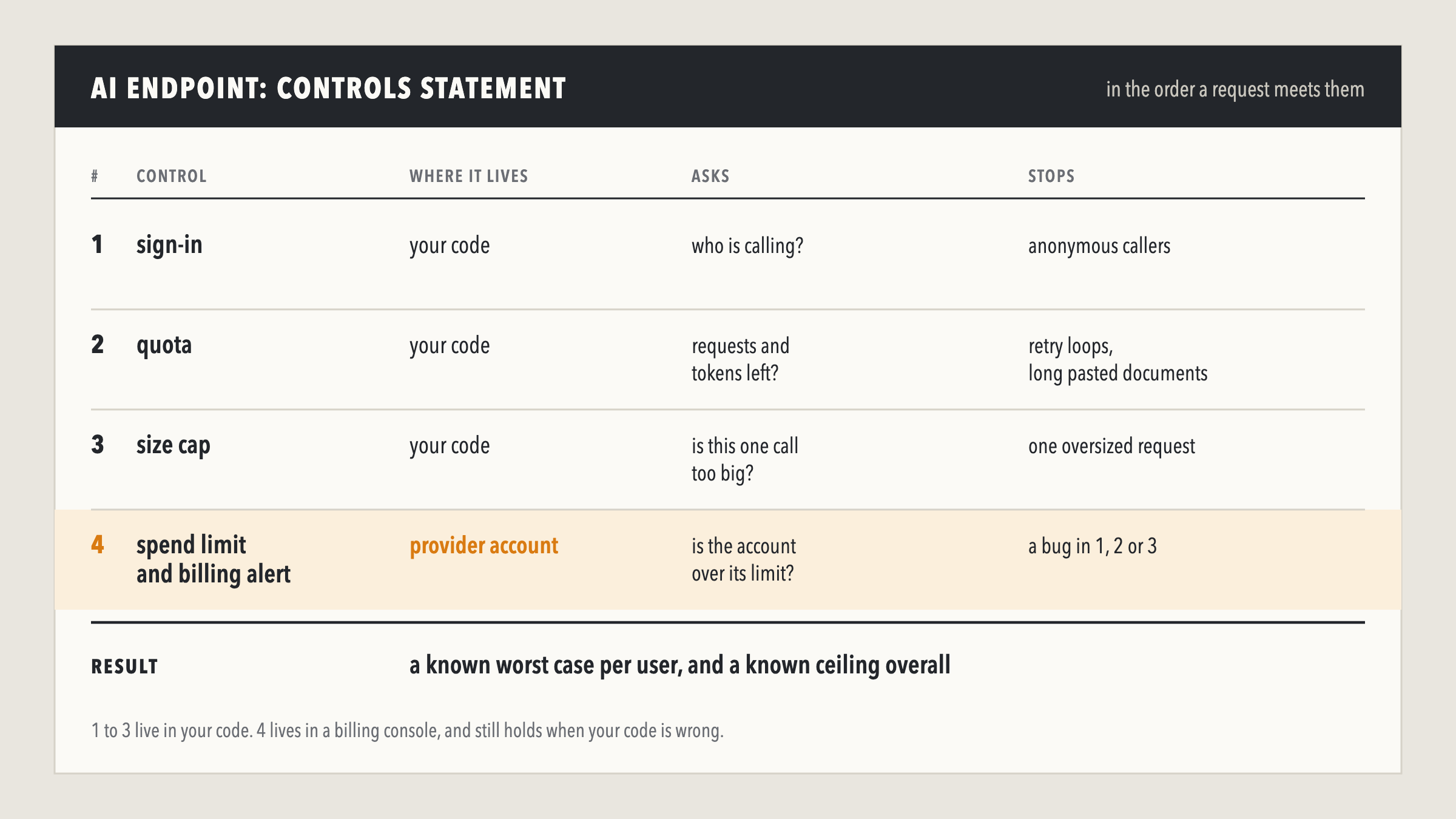
Require authentication on anything that reaches a model. Including the demo. Including the free tier. Including the little summarise button nobody uses. An anonymous AI endpoint is a public one, and the cheapest fix on this list is also the most commonly skipped, usually because the endpoint in question was meant to be temporary.
Give every user and organisation a quota, counting requests and tokens. Tokens matter as much as request count, and this is the part people miss: a hundred calls with a long document pasted into each one can cost more than ten thousand short ones. A quota that counts only requests will report healthy while the bill triples. Enforce it on your server, reset it on a window you chose deliberately, and return a clear error when it is hit.
Cap the size of every individual call. Set a maximum output length, cap the input length before you send it, and reject anything oversized in your own code rather than paying the provider to discover it was too big. This is the control that turns a pathological single request into a rejected one.
Set a spend limit and a billing alert with the provider. This is not a duplicate of your quota logic. It is what catches the bug in your quota logic, and it is the only control on this list that does not depend on your own code being right. Whatever you believe your application enforces, the provider account is the last line, and it is the one that turns a bad month into a bad afternoon.
The test, and the expensive way to fail it#
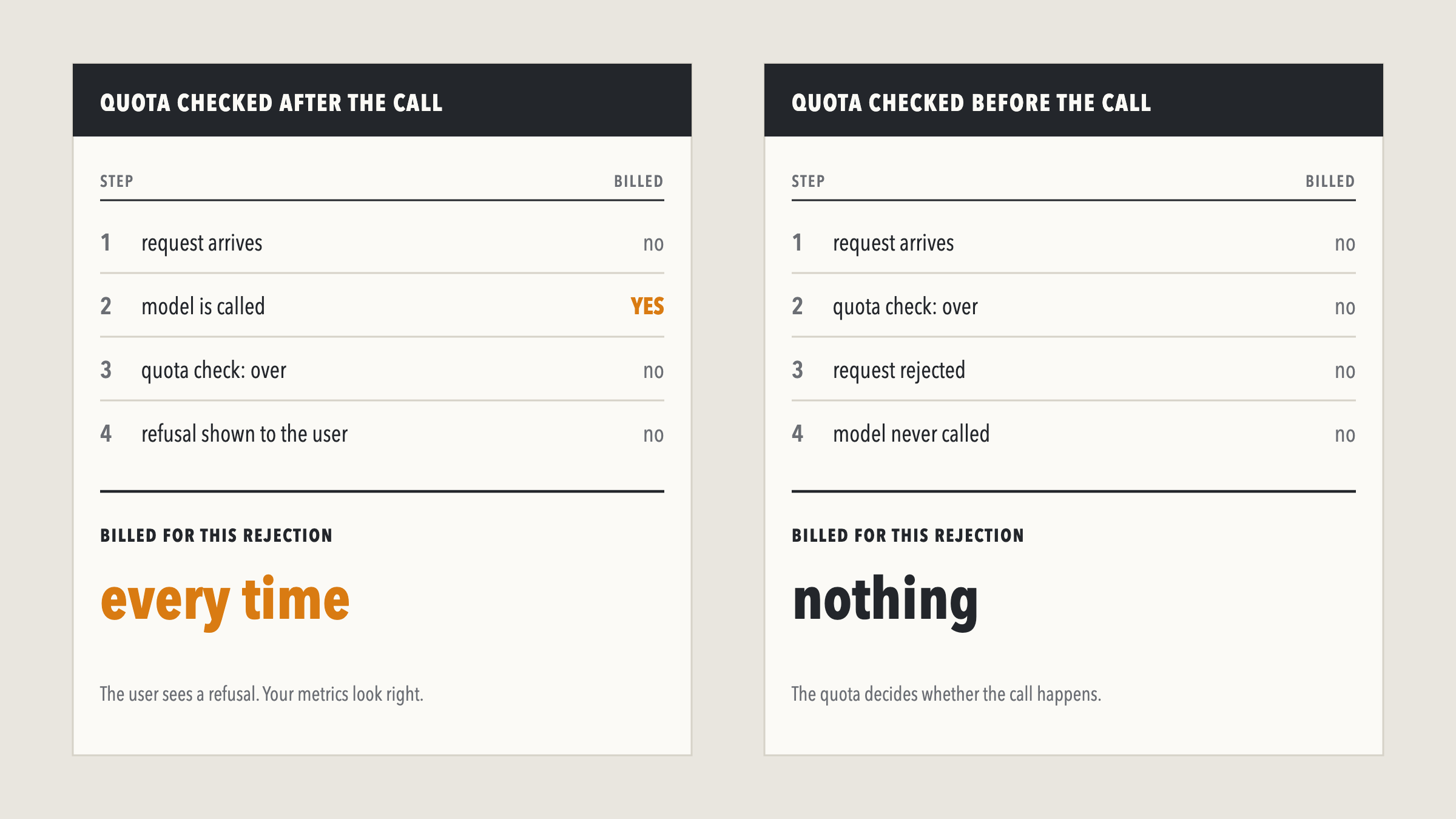
Take a test user, exhaust their quota, and keep calling.
You want two things to be true. The caller gets a clear rejection, and your provider dashboard shows no billed calls after the quota was hit.
The second half is the one worth checking carefully, because the expensive failure mode is a system that returns an error to the user after calling the model. The user sees a refusal, your metrics look correct, and you are paying for every rejection. That is a quota that costs you money to enforce, and it is more common than it sounds, because the natural place to add a check is wherever the response comes back.
If you own the budget rather than the code#
Three questions, and the answers tell you where you are:
- "Can anyone call our AI features without logging in?" If yes, you have an unbounded liability and the fix is small. This includes the marketing demo, which is usually the thing nobody remembers is still live.
- "What is the most a single customer can cost us in a day?" A good answer is a number, because a number means someone implemented a cap. "It depends on usage" means there is no ceiling, only a trend.
- "Is there a hard spend limit at the provider, and who gets alerted?" If the alert goes to a shared inbox or a channel, it goes nowhere. This is the control most likely to be missing, because it lives in a billing console rather than in the codebase.
The limits#
Capping cost is not the same as securing an AI feature. It does nothing about prompt injection, nothing about what the model is allowed to do on a user's behalf, and nothing about what happens to the data you send upstream.
It also will not protect you from a genuinely distributed abuse campaign on its own, where per-user quotas get spread across many accounts. That needs account-level signals and rate limiting at the edge, which is a different control.
What it buys is that your AI feature has a known worst case per user and a known ceiling overall, which is the minimum required before you can reason about it as a business decision rather than an open-ended commitment.
Without it, the most a single customer can cost you in a day is whatever they decide.
This is control 30 of a security baseline I maintain as an agent skill, where every control carries a verification step rather than a claim. I wrote about how that checklist works separately. It is public and MIT licensed at github.com/lawalOyinlola/appsec-protocols, and its limits are stated in DISCLAIMER.md.
Likes are saved in your browser only.
This post is also published on dev.to.
Keep reading
- 12 October 20269 minYour coding agent runs as you. So does everything you install into it.A skill passed every scanner, and the scanners were right at the moment they looked. Why the artefact you review and the instruction that runs are two different objects, and how to inventory what your coding agent can actually reach.
- 3 October 20269 minPrompt injection is an authority problem, not a wording problemMost prompt injection defences are a sentence in a system prompt, which asks the thing being attacked to defend itself. The alternative is architectural: the model never holds authority, and every tool call is re-checked against the user's own permissions.
- 25 September 20268 minA security checklist my coding agent has to runMost security checklists say what should be true and never get tested. Here is what happened when every item was rewritten as something you run, and packaged as a skill a coding agent loads before it writes the code.