From zero to tech lead: what the AltSchool year actually taught me
No background in tech, a repo that emptied itself two hours before a deadline, and a diploma in frontend engineering at the end of it. The year I spent at AltSchool Africa, and what it led to.
- career
- beginners
- webdev
- frontend
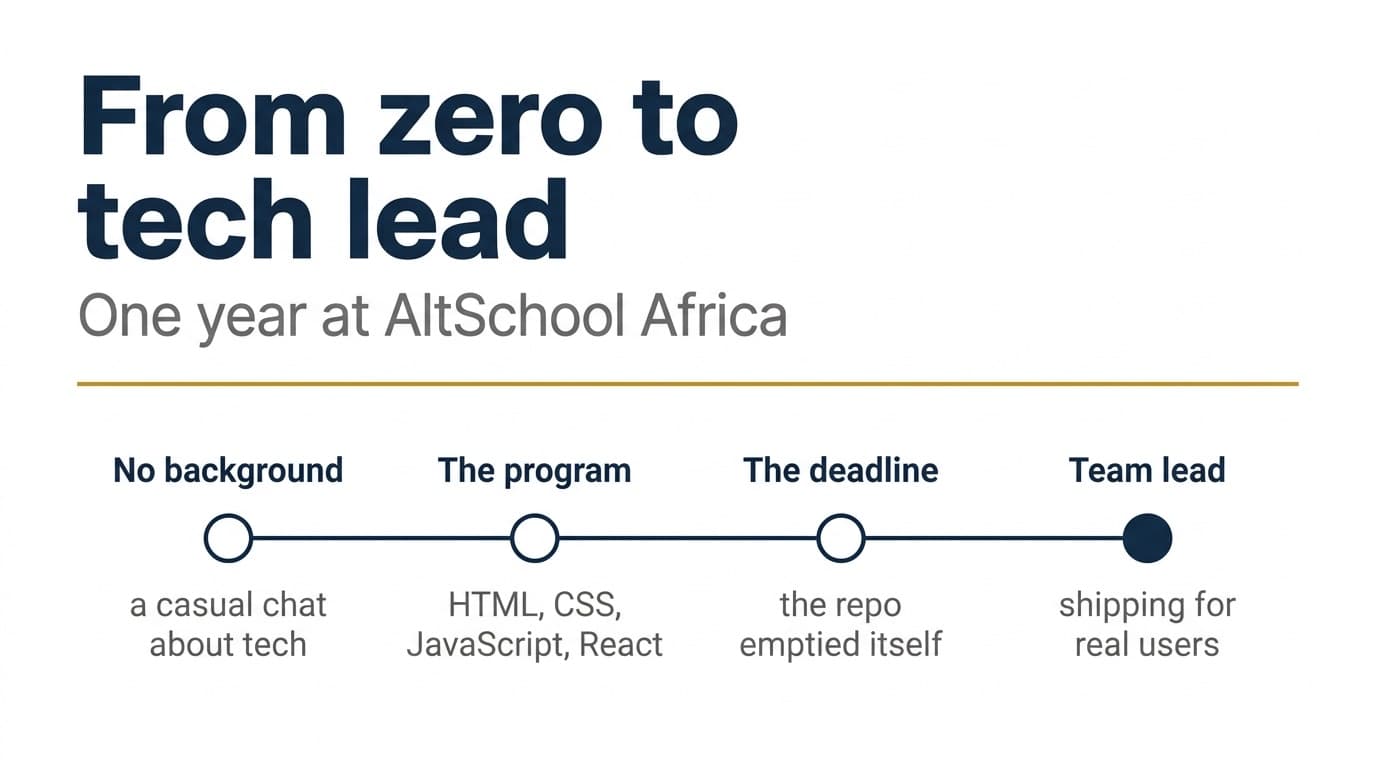
It has been over a year since I graduated from AltSchool Africa, and what a transformative ride it has been. From having no background in tech to leading software projects at Tech N' Goodwill Limited, my journey has been packed with lessons, mistakes, growth, and soft skills development.
It started with a casual chat#
It all started with a simple, casual conversation. I was wrapping up my national service year, uncertain about what the future held. During a chat with a friend about starting a career in tech, he mentioned AltSchool and even hinted at scholarships. I did not have a clue about tracks or specializations, but I knew I loved solving problems and creating websites that looked good. Frustrated by poorly designed apps and websites, I gravitated toward frontend engineering. PS: I did not get a scholarship.
The months before the program started#
On 27 October 2022 I registered, took the entrance exam, got in, and joined the Slack community. That is where the real magic began. I was anxiously waiting for the program to kick off, and days turned into weeks, weeks into months. While waiting, I dove into the community, sharing ideas, asking questions, and soaking up everything I could. Someone recommended the W3Schools Discord community, which turned out to be a treasure trove, filled with brilliant minds, eager to help and share.
That community taught me a vital lesson: do not wait for the perfect moment, start now. I took some courses on Udemy, especially Jonas Schmedtmann's HTML and CSS course, which was my first real step into coding.
When the sessions began#
Once the sessions started in March 2023, I was attending live classes, consuming online resources, and studying with external materials. Our tutors were incredible, constantly urging us to read ahead, explore documentation, and learn independently. They kept telling us, "Things will not always be this slow; the real work is coming." They were right.
Two hours before the deadline, my code was gone#
Fast forward a few months, and the first semester exams and assessment projects arrived. Like many, I procrastinated, relaxing and learning but not actively building. When I finally started, I finished the project and was about to submit. I made my first commit, pushed to GitHub, then wanted to make some tweaks. I successfully pushed my code, but it was not showing up on GitHub. I kept checking, sweating, frustrated, until I realised my codebase on my computer was gone. The repo was empty. Less than two hours before the deadline.
E shock me! What now? Give up? Call it a day? Nope. I grabbed my laptop and started from scratch. That moment turned out to be my biggest lesson. I rebuilt about 70% of the project in just an hour, spotting errors, correcting them, simplifying my code. I was more proud of that second version than the first. I submitted just before the deadline, exhausted but victorious. Later I emailed the facilitators asking for an extension. Luckily I was not the only one who needed extra time, and I got it, which let me finish the project properly.
What the community taught me that the courses did not#
What I loved most about this journey was the AltSchool community: meeting brilliant minds, peers, tutors, mentors, facilitators, instructors, circle members, guest speakers, and organizers. The soft skills I learned, writing, content creation, collaboration and leadership, were just as vital as coding.
I remember thinking HTML and CSS were enough to conquer the world. In Setemi's unmistakable voice: "boom!". His guidance, recommendations, and relentless pushes kept me going through the toughest moments. He would tell us to read ahead, explore documentation and learn independently, and he meant it. His advice was not just about coding, it was about developing the mindset to grow beyond limits. One of the most impactful resources he shared was the Learning How to Learn course on Coursera by Deep Teaching Solutions, an eye-opener that transformed how I approached learning.
JavaScript, Vue and React#
In the following semesters I dove into JavaScript, Vue and React. I also took more of Jonas Schmedtmann's courses, The Complete JavaScript Course and The Ultimate React Course. These took me from a complete beginner to a confident developer.
The capstone: ScissorsWeb#
My capstone project was a URL shortening web app called ScissorsWeb. It shortens URLs with custom text or emoji aliases, generates QR codes, and handles authentication, database storage using Supabase, analytics, error management, theme modes, and animations with GSAP, all built with React and TypeScript. It was a fun, challenging way to put everything I had learned into practice. You can read the case study or try the live app.
Graduating#
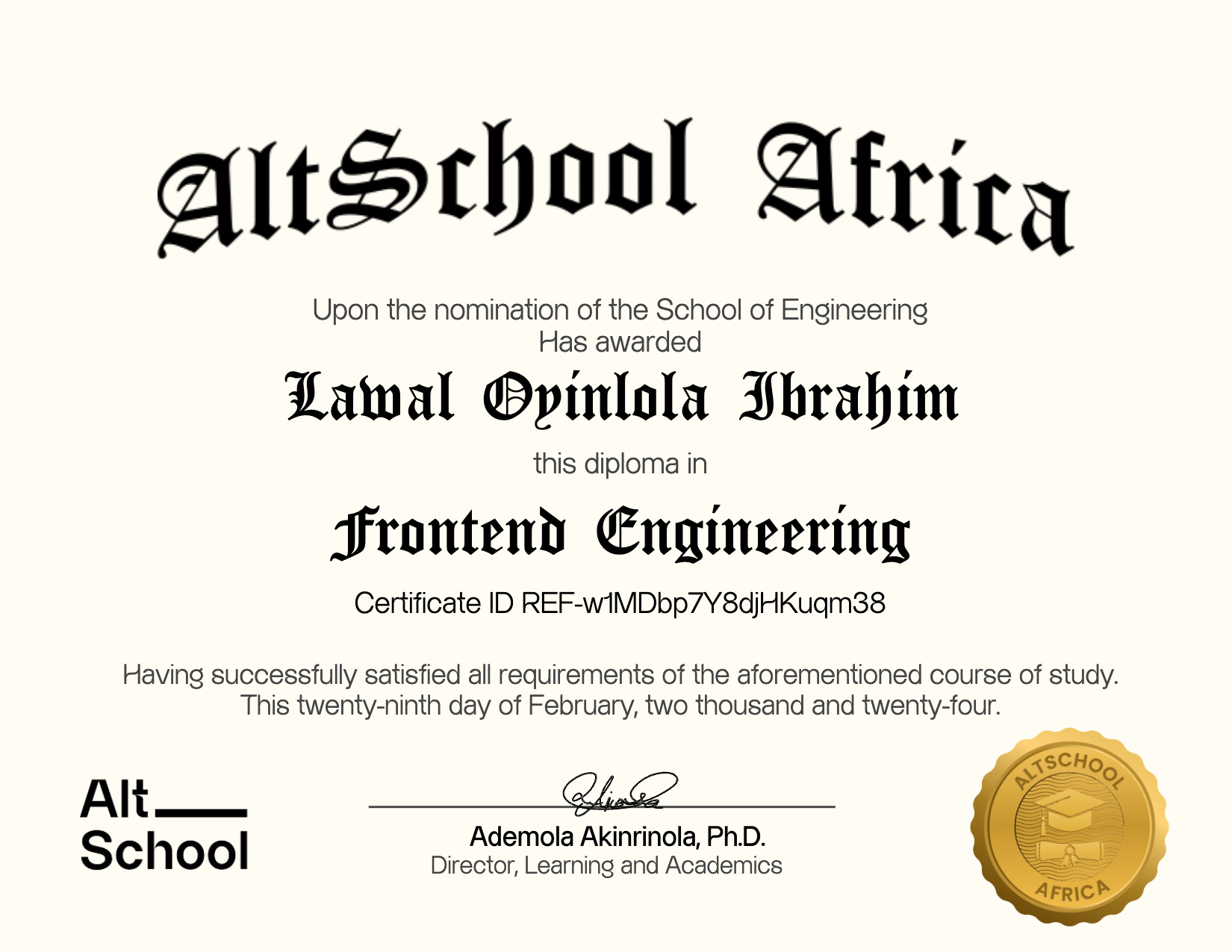
Fifty two weeks of learning, over 120 live sessions, and a pile of assessments later, the diploma arrived.
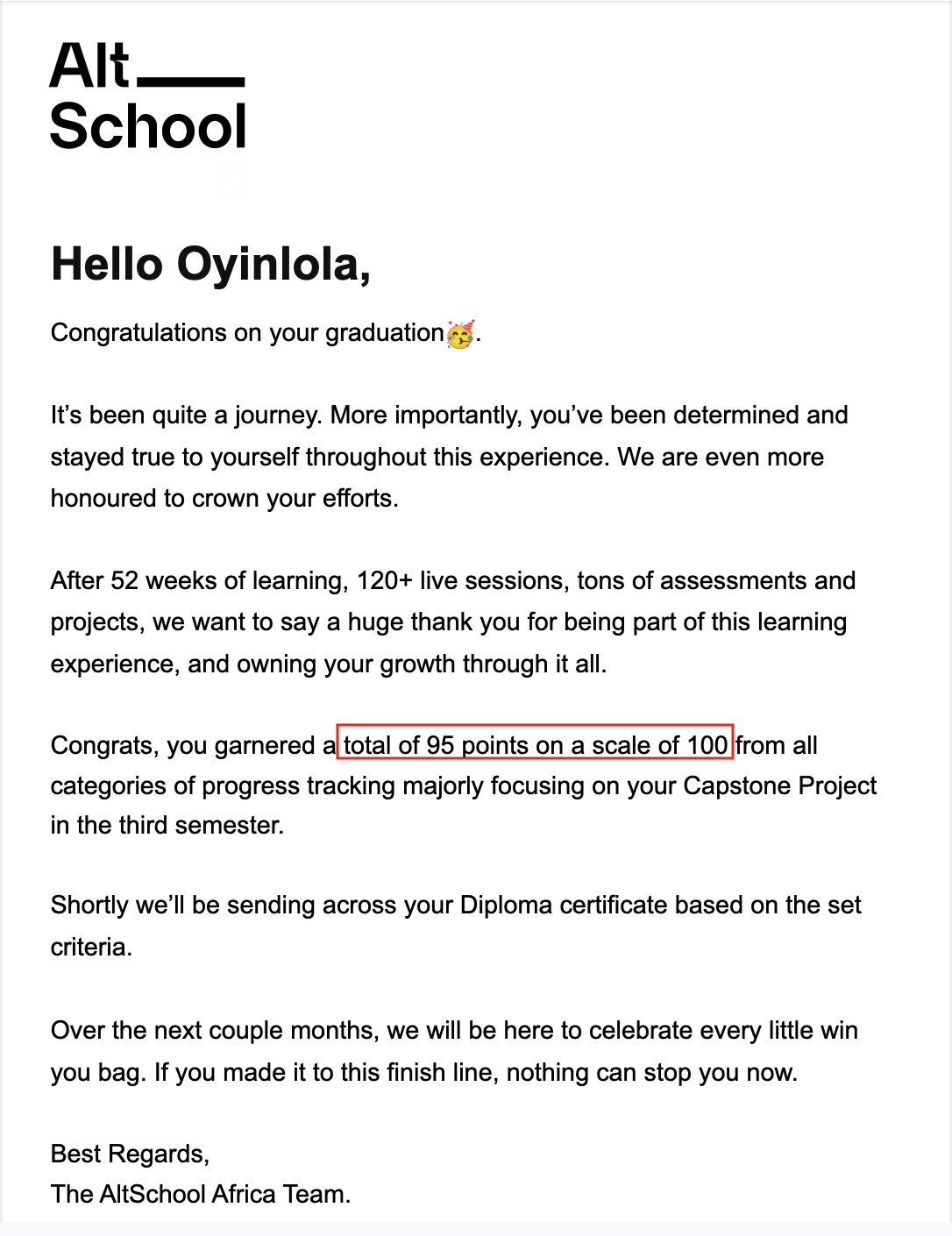
The graduation email put a number on it: 95 points out of 100 across all categories of progress tracking, weighted heavily toward the capstone project.
Where I am now#
Since then I have been building production software rather than coursework. I am a Software Developer and Team Lead at Tech N' Goodwill Limited, where much of my work went into SafulPay, a fintech product in Sierra Leone, across the mobile app, the agent and merchant dashboards, and the corporate site.
Right now I am building Trakkam, a GPS and IoT platform for fleet monitoring: live tracking, alerts, and a web dashboard, plus a WhatsApp bot for the people who would rather ask a question in a chat than open another app. It is self hosted, so the infrastructure, the deployments and the hardening are mine to get right too.
That is also what changed what I am curious about. Building payment software and then hosting a tracking platform yourself makes you think hard about what happens when someone attacks it, so I have started working through security properly and writing down what I find. I measured what a web application firewall actually blocked in front of an app I had already built, and wrote up the vocabulary and the rules of ethical hacking for anyone starting where I am. More of that is coming, including the lab work behind it.
The through line from the empty repo two hours before a deadline is the same one I would offer anyone starting out: the moment something breaks is usually the moment you actually learn the thing. Keep building, and keep writing down what breaks.
Likes are saved in your browser only.
Keep reading
- 14 September 202610 minWhat my WAF actually blocked, and what my app already stops on its ownI ran 26 attack payloads against a production app with ModSecurity on and off. It blocked 12: five my app already rejected, and seven it stopped a step earlier than the app's own defences. The class behind most real breaches never showed up in either column.
- 10 September 20267 minEthical hacking is not a toolset, it is a mindset with a permission slipHacker, ethical hacker and penetration tester are not the same thing, and one of the differences is an invoice versus a criminal record. The mindset, the seven-stage method, and the black, grey and white box styles, laid out plainly.